Custom LLM vs Off-the-Shelf: Navigating AI Platform Decisions

Deciding between a custom AI model, an off-the-shelf solution, or a hybrid approach? Each has trade-offs in cost, control, and scalability. Here’s how to choose the best option for your business needs and goals.
1. Fully Custom LLMs
Building a proprietary LLM from the ground up.
Advantages
Full Control Over Capabilities & Optimization
- Can be trained specifically on domain-specific data to outperform generic models.
- Tailored fine-tuning for superior accuracy, relevance, and compliance.
Data Security & Compliance
- Sensitive data remains within the company’s control.
- Easier to meet stringent industry regulations (e.g., HIPAA, GDPR, SOC 2).
Competitive Differentiation
- Proprietary AI can become a strategic moat.
- Potential licensing or monetization opportunities.
Disadvantages
High Cost & Complexity
- Requires extensive compute resources, skilled talent, and infrastructure.
- Training and inference costs can be significantly higher than off-the-shelf solutions.
Longer Time to Market
- Developing a high-quality model can take months or even years.
- Requires iterative fine-tuning and evaluation.
Ongoing Maintenance
- Needs continual updates to remain relevant and competitive.
- Risks of model drift, bias, and security vulnerabilities.
2. Off-the-Shelf LLMs (ChatGPT, Gemini, Claude, etc.)
Using pre-built AI models via APIs or cloud services.
Advantages
Fastest Time to Market
- Can be integrated within days or weeks.
- No need for in-house AI expertise.
Lower Costs (Upfront & Maintenance)
- No need to invest in expensive infrastructure.
- Pay-as-you-go pricing with predictable costs.
State-of-the-Art Performance
- Access to cutting-edge AI without having to train it.
- Providers continuously update and improve their models.
Disadvantages
Limited Customization
- Fine-tuning options are often restricted.
- May not perform as well on niche or proprietary tasks.
Data Privacy Concerns
- Customer data is sent to third-party servers (potential compliance risks).
- Control over data retention and security is limited.
Vendor Lock-in
- Dependence on external providers for model updates and pricing.
- Sudden changes in API costs or terms can impact business continuity.
3. Hybrid Approach
Combining off-the-shelf models with proprietary data and fine-tuning.
Advantages
Best of Both Worlds
- Leverages pre-trained models while allowing customization.
- Can fine-tune smaller, domain-specific models for performance gains.
Faster Development with Customization
- Avoids the heavy lift of training from scratch.
- Fine-tuning or using Retrieval-Augmented Generation (RAG) enhances domain relevance.
More Control Over Data & Compliance
- Sensitive operations can be handled in-house while still benefiting from cloud AI.
- Hybrid deployment options (e.g., using an API for general queries but a local model for sensitive data).
Disadvantages
Moderate Complexity & Costs
- Requires some ML/AI expertise for fine-tuning.
- Ongoing model maintenance still needed, though less than fully custom models.
Integration & Performance Balancing
- Requires careful orchestration between different AI components.
- May need additional infrastructure to manage hybrid workflows.
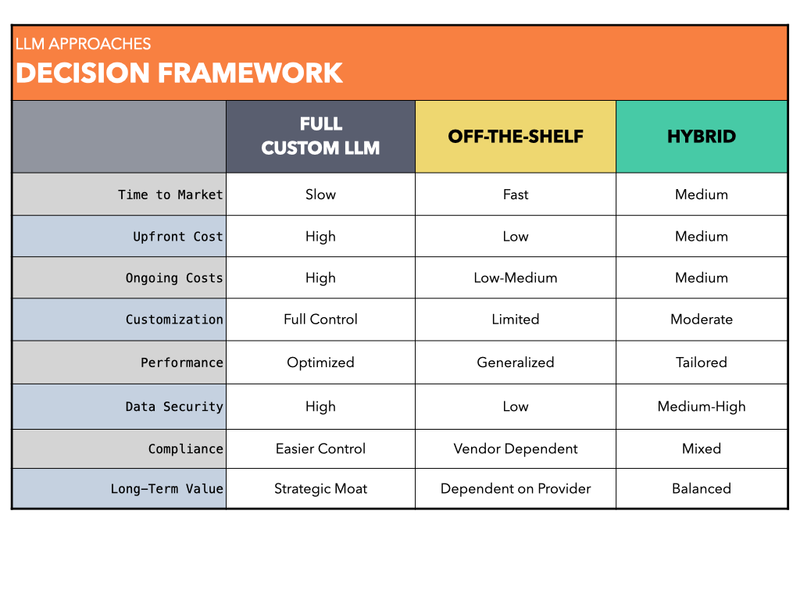
Decision Framework: Which Approach is Best?
Want to explore more about building a tailored LLM & AI strategy for your business?
Get in touch!

Elliott Torres
Elliott is the CTO of Foxbox and serves as Fractional CTO to our clients. He is responsible for setting the technical and delivery standards of our product design & development teams. With over 30 years as a solution architect and technology executive, Elliott’s known for leading highly successful AI & ML initiatives, particularly in healthcare. Elliott’s track record as an outcome-focused technical leader is invaluable to the Foxbox team. Read more about Elliott Torres